

After son’s transfer, family sees what future La Grange NICU could change
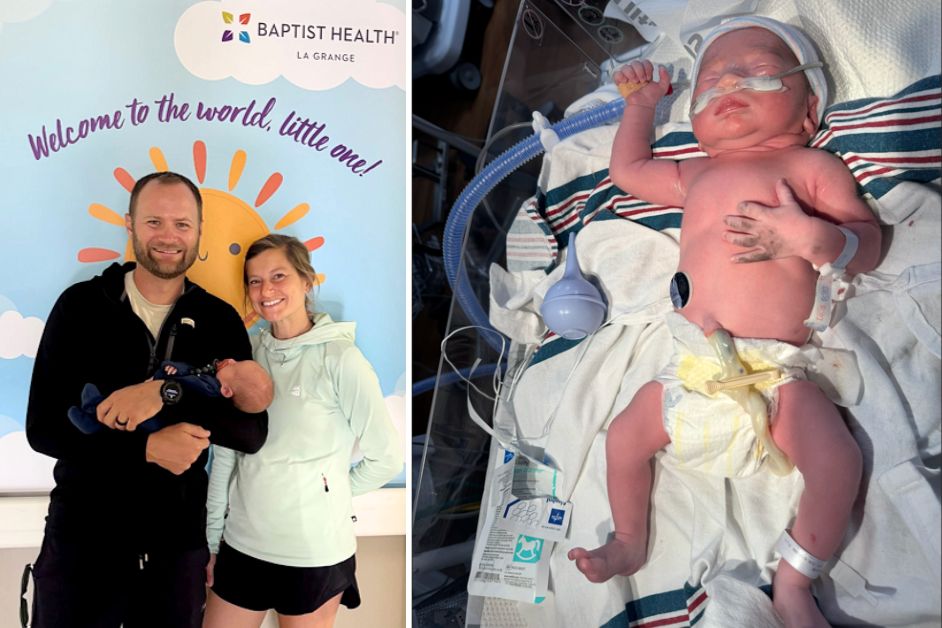
When it came to delivering their children, Jonathon and Krista Lindner chose Baptist Health La Grange because it was the place they trusted.
Jonathon Lindner, MD, grew up in Oldham County and was practicing as an orthopedic surgeon with Baptist Health when their daughter was born at Baptist Health La Grange in 2023, a choice they made even though other hospitals were closer to home. His wife Krista came away from that delivery especially certain they had found the right place.
“It was so patient-focused,” she said. “They truly cared about me and the baby.”
When she became pregnant with their second child, Beau, they planned to return. Then, her water broke at 35 weeks and two days.
“I still wanted to go out to La Grange because that was the team that had been following me throughout my pregnancy,” she said. “They knew my story.”
Beau was born by C-section that evening.
“He made one scream and then there was no noise at all,” Krista said.
His oxygen levels were low, and his blood sugar was off. The team at Baptist Health La Grange immediately began working to help him breathe.
“I was watching Jonathon's face and he was terrified, so I knew that things were bad,” she said.
Being a physician did not give him much reassurance.
“I think it's kind of hard being in healthcare, because you know just enough to be dangerous,” Jonathon said.
He knew enough about low oxygen levels to understand what could go wrong. But neonatal medicine is far outside of his specialty.
“It’s pretty terrifying to have a kid that needs a higher level of care,” he said.
Krista’s first hours after delivery were marked by what was missing, especially compared with the delivery of their daughter just a few years earlier.
“Right when I had her, she was healthy, everything was good, and they put her on my chest and I lost it,” she remembered. “It was such an awesome moment.”
With Beau, she waited while the team cared for him.
“You go your whole pregnancy wondering what he’s going to look like. What color are his eyes? What color is his hair?” she said. “And then you have no idea what he looks like. You have no idea how he is.”
The team at Baptist Health La Grange cared for Beau for several hours. But when it became clear he needed NICU-level support, it was decided his care would continue at a downtown children’s hospital.
Beau was already prepared for transport when one member of the crew stopped.
“The lead guy was like, ‘No, no, no, we're not leaving until she holds him,’” Krista recalled.
“That was really important for her,” Jonathon said. “Just to see him, just to hold him before he got whisked away while she was still in La Grange.”
It’s the part of their story that still catches him. Months later, he paused while talking about watching Beau leave.
“Sorry, I get worked up,” he said.
“You just, as a new mom, kind of feel empty inside,” Krista said. “I need him as much as he needs me right now, and we’re completely separated by quite a distance.”
Having just undergone a C-section, and then developing postpartum preeclampsia, Krista needed to remain at La Grange for her own care while Beau was admitted to the NICU downtown.
Jonathon began moving between two hospitals.
“Having to choose between spending time with my wife, who just went through a relatively traumatic experience and being there for our newborn son, who’s pretty ill – I think not having to split time would have been a much better experience for everybody involved,” he said.
That includes their daughter. She had been at the hospital when Krista went into labor, and staff even found a way for her to peek into the nursery while they worked to stabilize her new sibling.
“She was so excited to meet her new baby brother,” Krista said. “After he was transferred, it was 12 days before she would get to see him again. She was heartbroken.”
Krista spent about a day and a half at Baptist Health La Grange before she could get to Beau. During his nearly two-week stay in the downtown NICU, there were still plenty of times she and Jonathon had to leave and go home without him.
“I would watch the camera they had on him in the middle of the night and cry, feeling helpless and longing to be with him,” she said. “I wanted so badly to comfort him when I saw he was upset. Several nights I told Jonathon I was leaving to go and be with him. He would talk me out of it and remind me that I needed to rest and recover too so that I would be strong for him when he did make it home.”
Today, months after discharge, Beau is doing well.
“He's gaining weight and getting bigger,” Krista said. “He's doing much better.”
The Lindners tell their story not because they believe anything about his care should have happened differently. They are grateful for the compassion of every caregiver at Baptist Health La Grange, and that additional care was within reach for their son when he needed it.
Their hope is that future families can receive that same level of care without being separated.
Baptist Health La Grange plans to build a four-bed Level II Neonatal Intensive Care Unit, extending the care already available to mothers and newborns when a baby needs more support after delivery. The unit will provide additional monitoring, feeding support, and short-term breathing assistance for babies who need more than routine newborn care, but do not require the highest levels of intensive care.
The hospital currently delivers babies at 35 weeks, just as it did with Beau. With a Level II NICU, Baptist Health La Grange will have the resources to care for babies born after 32 weeks or weighing at least 1,500 grams.
Those added capabilities can change the experience for an entire family. A baby may be able to remain in the same hospital as a mother recovering from surgery. Parents can hear updates firsthand. Early feeding and bonding can happen between mother and baby. A father may no longer have to decide which hospital needs him more.
In the last year, 385 babies were born at Baptist Health La Grange to families representing 16 counties across Kentucky and Indiana. 24 newborns had to be transferred elsewhere for specialized care.
The distance often adds layers of physical and emotional strain for families, especially recovering mothers.
“I feel like I forced my own recovery just to get out of there and get back to Beau,” Krista said. “You also have to start the whole breastfeeding journey without the baby there, which is tough.
There were a lot of aspects that I hadn’t really thought about," she continued. "You're having to travel to another hospital, park, carry in food and all your supplies for the day, spend as much time with your child as you can physically handle, go home, and repeat it every day until they're discharged.”
The $5 million project is supported by a $1 million gift from Kosair for Kids and will be named the Kosair for Kids NICU. Construction is expected to begin in late 2026, with the unit anticipated to open in early 2028.
Bringing the NICU fully to life will take a broader community investment in what families should be able to count on when they come to Baptist Health La Grange to have a baby.
“The experience that I've had with patients from this area is that they don't want to leave to get the care they need,” Jonathon said.
He jokes about just how strong that preference can be.
“You ask them to cross the Gene Snyder and it's like asking them to drive to a different country.”
Jonathon knows the community well, having grown up in Oldham County and choosing to return as a physician. People want excellent care, but they want it close to the family, friends, and familiarity that really make a place feel like home. Trust in who is providing that care matters, too.
For the birth of their daughter, and even more so when Beau came early, Jonathon and Krista intentionally chose Baptist Health La Grange. The NICU is an opportunity for the community to choose Baptist Health La Grange, too, and invest in a place families already seek out and provide the resources to strengthen its care.
That personal touch and the way people show up for others is how Krista explained what connected their family to the hospital from the beginning.
“It was like I was part of their family,” she said. “You feel like you’re part of something there.”
“The experience that I've had with patients from this area is that they don't want to leave to get the care they need.”
Jonathon Lindner, MD