

Training EMTs, Strengthening Communities
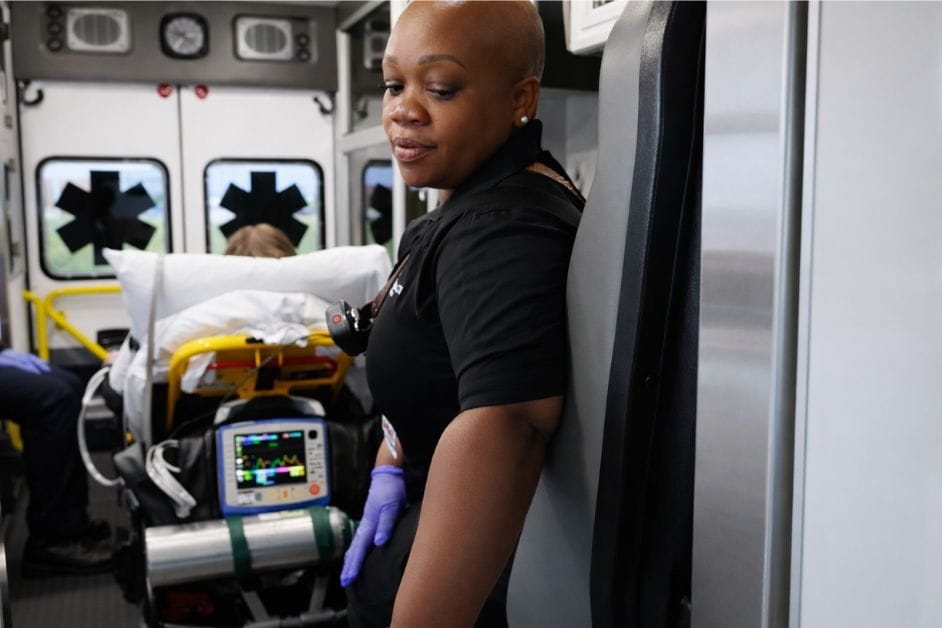
From the start, the purpose of the Baptist Health Emergency Medical Technician (EMT) Training Program has been access – access to care when seconds matter, and access to education for people who want to serve their communities but haven’t always had a clear path into healthcare.
The idea began with Keith Smith, System Director of Ambulance and Emergency Medical Services, whose more than 40 years in the EMS field – including 12 with Baptist Health – have given him a front-row view of the growing strain on emergency services across Kentucky. In 2019, a state Board of EMS report revealed workforce demographics did not reflect the communities it served, reinforcing challenges Keith had seen throughout his career and motivating him to act.
“A career field is not going to be successful if you don’t represent the people in the community,” Keith said. “When I was promoted to this position with Baptist Health, I felt like it was time to help make a change.”
Keith reached out to Annabelle Pike, Director of Community Health and Engagement, to put plans for the EMT program into action.
“I knew I needed someone who was connected in the community to assist me,” Keith said. “I like to think I had the vision and Annabelle heard the word, ‘go’ – and she ran with it!”
The two divided and conquered. Keith tackled the regulatory, technical and clinical requirements, while Annabelle leaned into what she does best – relationships, outreach and logistics – calling workforce partners, identifying locations and helping remove obstacles that often keep people from entering healthcare careers.
“The first goal of the program is to reduce the barrier of entry into healthcare, a notoriously high-barrier-to-entry field with collegiate requirements,” Annabelle explained.
That focus shaped every element of the program. The EMT Training Program is offered at no cost to participants. Baptist Health covers tuition, textbooks, learning materials and the required national background check. Participants must be at least 18 years old and hold a high school diploma or GED.
Recruitment efforts were intentionally community-based, conducted in partnership with three workforce development organizations – the Goodwill Young Adult Opportunity Campus in Louisville, the Kentucky Career Center–Lincoln Trail in Elizabethtown and Southern Indiana Works in New Albany. The result was a cohort that reflects the areas it aims to serve.
The program also uses a hybrid model – another innovation for Kentucky – combining self-directed online trainings with in-person “skills days” that utilize hands-on learning. Lessons include lifting and moving patients, taking vital signs, controlling bleeding, responding to chest trauma, OB/GYN emergencies and caring for patients with special challenges.
The first cohort launched in January 2026 and will continue through May. Graduates will be eligible to sit for the National Registry of Emergency Medical Technicians (NREMT) exam and, once certified, pursue EMT roles with the emergency department of their choosing – ideally one within Baptist Health.
“Our hope is to have an 80% success rate or better,” Keith said.
The need could not be more urgent. In both Kentucky and southern Indiana, staffing shortages threaten timely emergency response. By creating a direct, supported pathway into EMS careers, the Baptist Health EMT Training Program strengthens the chain of care, ensuring ambulances arrive on time and patients are covered when emergencies arise.
Grant funding from Truist Foundation was essential to making the program come to life.
“Without the support of Truist Foundation, this would not have been possible,” Keith said. “We are so thankful for their help.”
The grant funding removes financial barriers for individuals who would otherwise not have access to EMT education, creating opportunities that change trajectories and strengthen local resources long term.
“To my knowledge, we are the first healthcare entity to offer an EMT program at no cost to students in the hopes of these students working throughout the community for EMS providers, fire departments or hospitals,” Keith said.
The EMT Training Program is a model of what’s possible when community partners and philanthropy align around access – to education, impactful careers, and ultimately, life-saving care – delivered by people who understand and reflect the communities they serve.
The stakes are impossible to ignore.
“People don’t think about EMS until they need to use it,” Keith explained. “Imagine having a heart attack or stroke but having nobody to call for assistance – or being the person pulled from a horrific car accident and being told to call a cab to get to the hospital.”
With continued support, Baptist Health envisions expanding the program’s reach and opening doors for the next generation of caregivers. The future of emergency care depends on more people being prepared to serve, and this program is making sure there are.
“EMTs do work that few people see, but it’s an invaluable career where you truly make a difference in people’s lives,” Keith said.
“EMTs do work that few people see, but it’s an invaluable career where you truly make a difference in people’s lives.”
The Dawn of a Healthier Tomorrow
Please consider partnering with us through the power of your advocacy and philanthropy. For information on how to donate, click the link below. You may also give us a call if you have questions.